
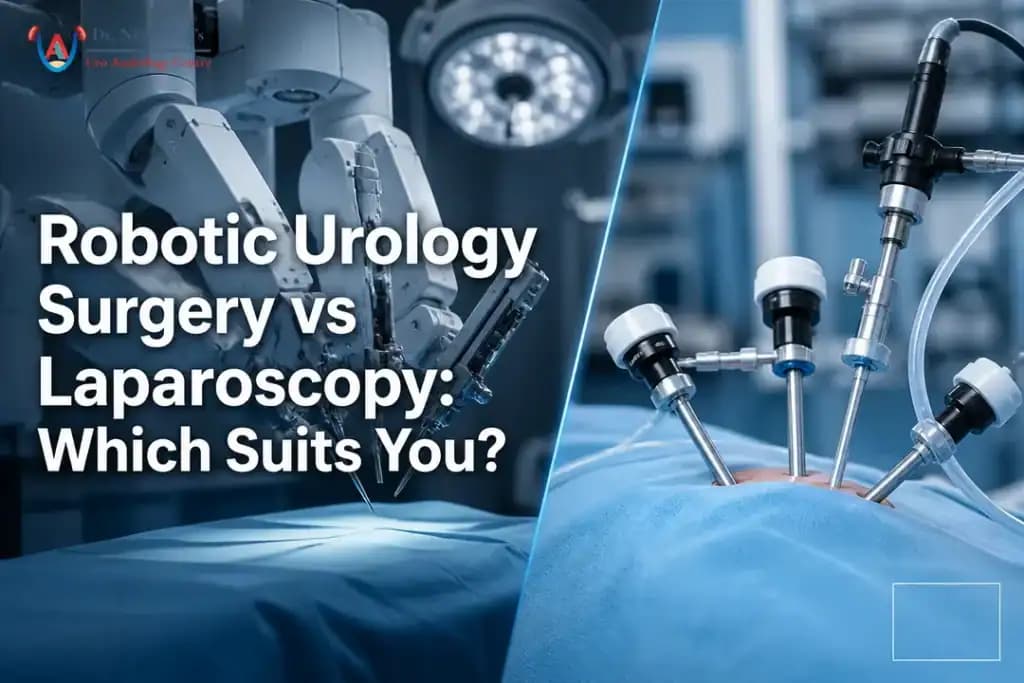
If you are comparing options for a urology procedure, this guide explains robotic urology surgery vs laparoscopy in plain language. Our clinic wrote Robotic Urology Surgery vs Laparoscopy: Which Suits You? to help you weigh benefits, limits, recovery, and costs with your urologist before you decide.
What are these two approaches?
robotic urology surgery: key steps
Surgeons perform this minimally invasive approach through a few small ports. They sit at a console and control robotic arms that move tiny wristed instruments. The system converts hand motions into steady, precise movements inside the body.
Console, ports, and 3D vision
The console gives a high‑definition 3D view that magnifies anatomy. Ports go through 5–12 mm incisions. The robotic arms hold instruments and a camera. Because the tools articulate, the surgeon can suture or dissect in tight spaces with fine control.
What happens in laparoscopy
Laparoscopy also uses small incisions and a camera. However, the surgeon stands at the table and moves straight instruments by hand. Many urology operations, like kidney stone removal and simple nephrectomy, can be done laparoscopically with excellent results.
Both techniques avoid large open cuts. Consequently, patients usually see less blood loss, smaller scars, and faster mobility than with open surgery.
Robotic surgery in urology: safety and limits
Minimally invasive surgery reduces wound size, which often means less pain and a shorter hospital stay. According to NIH MedlinePlus on laparoscopy, smaller incisions typically speed recovery compared with open methods.
Safety also depends on team discipline. The WHO Surgical Safety Checklist has been associated with lower complications and mortality when hospitals use it consistently. Therefore, ask whether your hospital follows this checklist.
Robotics add technology that enhances dexterity and vision. Yet, they require more setup time and careful port placement. Not every hospital has the platform, and availability may influence scheduling and cost.
In our day‑to‑day work at a high‑volume urology clinic in Jaipur, we see that outcomes depend more on surgeon experience, case selection, and perioperative care than on a single tool. Because of this, we match the technique to the diagnosis rather than the other way around.
When robotic urology surgery makes sense
For complex pelvic procedures, the console’s 3D view and wristed tools can offer an advantage. For example, during prostate cancer surgery, the fine suturing helps reconstruct the bladder neck and preserve continence mechanisms when anatomy allows. Similarly, in partial nephrectomy for certain kidney tumors, the articulation can aid precise tumor excision and renorrhaphy.
Evidence supports these practical benefits. The U.S. National Institute of Diabetes and Digestive and Kidney Diseases (NIDDK) notes that prostate enlargement is common—about half of men by age 60 and up to 90% by older age. As prostate problems and cancers rise with age, surgeons increasingly use minimally invasive approaches to reduce bleeding and hospital stay in suitable patients.
We often recommend the console‑assisted route for: localized prostate cancer needing radical prostatectomy; selected kidney tumors planned for partial removal; reconstructive procedures like pyeloplasty for hydronephrosis; and complex re‑do surgeries with scar tissue. In these situations, precise suturing and wristed motion can shorten warm ischemia time in kidney surgery or improve ergonomics during deep pelvic work.
However, technology alone does not guarantee a better outcome. Tissue quality, body habitus, prior surgeries, and the specific disease stage still drive results. Therefore, we review imaging, lab reports, and goals before proposing a plan.
Where laparoscopy still excels
Laparoscopy remains a strong choice for many urology cases. It uses familiar instruments, has low equipment costs, and offers excellent visualization with modern cameras. For straightforward procedures, such as simple nephrectomy, varicocele ligation, or diagnostic evaluations, an experienced laparoscopic team can complete the surgery quickly and safely.
Moreover, for selected kidney stone treatment scenarios—like ureterolithotomy for an impacted stone—laparoscopy can provide a direct, efficient route. That said, most stones today are handled by endoscopic and laser methods rather than abdominal surgery. Your surgeon may discuss laser kidney stone surgery, ureteroscopy, or percutaneous nephrolithotomy depending on stone size, location, and kidney health.
In cost‑sensitive settings, laparoscopy may reduce the hospital bill. Not every patient needs a robot, and not every hospital requires one for great results. Because of this, a center that offers both options can individualize care without overspending.
Costs, recovery, and choosing with your surgeon
Pain, scars, and hospital stay
Compared with open surgery, both options typically reduce pain and time in hospital. Patients often go home within one to three days for common procedures, assuming no complications. Small incisions also mean fewer wound problems and less scarring for most people.
Robotic platforms may add a technology fee, which varies by hospital. Laparoscopy usually costs less because the instruments are simpler. Nevertheless, a shorter stay and faster return to work can offset costs for some patients, especially when living far from the hospital.
Recovery depends on procedure type. For example, after prostate treatment or BPH surgery, you may need a catheter for a few days. After kidney stone removal, you may pass small fragments and should drink extra water. Importantly, your team will tailor pain control, antibiotics, and activity advice to your case.
Here is a quick way to frame your decision with your care team:
- Your diagnosis and goals: cancer control, symptom relief, or stone clearance.
- Your body and medical history: prior surgeries, BMI, bleeding risk, or heart issues.
- Surgical complexity: depth in the pelvis, need for suturing, and tumor location.
- Surgeon experience: who has done more of your specific operation successfully.
- Hospital support: ICU backup, checklist culture, and 24/7 imaging and labs.
- Budget and logistics: insurance cover, travel distance, and time off work.
As you compare, speak with an experienced urologist. For an overview of services and appointments in Jaipur, visit the Dr. Nitin Negi urology clinic. You will find patient‑first guidance on prostate health, kidney stone removal, urinary tract infection care, and men’s health issues.
Because many readers ask, here are procedure examples often discussed in clinic:
Prostate treatment: For enlarged prostate (BPH), many men do well with medicines first. If symptoms persist, minimally invasive options such as laser prostate surgery, TURP, or enucleation can relieve blockage. For prostate cancer awareness and treatment, your team may discuss active surveillance, radiation, or surgery depending on stage.
Kidney stone management: We tailor care to stone size and location. Options include medical expulsive therapy, shockwave lithotripsy, ureteroscopy with laser kidney stone surgery, or percutaneous nephrolithotomy for larger stones. Preventive advice covers hydration, dietary sodium limits, and citrate intake to reduce recurrence.
Urinary tract and bladder problems: Recurrent UTI symptoms, urinary incontinence, hematuria, or urinary retention require careful evaluation. Imaging and cystoscopy help spot strictures, stones, or tumors. Early assessment protects kidney health and prevents emergencies.
Male health topics: Andrology covers erectile dysfunction, male infertility, and hormone issues. A discreet, evidence‑based plan can improve confidence and quality of life.
Ultimately, your selection between the two techniques should reflect your condition and the team’s strengths. To make an informed choice, ask your surgeon these questions:
- Which approach do you recommend for my diagnosis, and why?
- How many of these procedures have you completed in the last year?
- What is the expected hospital stay and catheter time for me?
- What complications should I watch for at home, and whom do I call?
- How do costs differ at this hospital, including device fees and supplies?
In our practice, we present both roadmaps. Then we co‑design the plan that best balances cancer control or symptom relief with safety, recovery time, and budget. We also coordinate with anesthesia, nursing, and physiotherapy so each patient knows exactly what to expect.
If you want a preliminary discussion, you can start by calling our front desk or reading more on the official website of Dr. Nitin Negi. We strive to translate complex surgical choices into clear next steps.
Before we close, remember one balanced point. Technology supports the human skill behind it. A seasoned team, robust protocols, and honest communication remain the keys to good outcomes—whether you choose laparoscopy or robotic platforms.
In summary, robotic urology surgery vs laparoscopy is not a contest with a single winner. Rather, it is a toolkit: robotics can enhance precision in deep pelvic or reconstructive work, while laparoscopy offers speed and value in many straightforward cases. Discuss your diagnosis, goals, and resources with your surgeon, and choose confidently.
Finally, if you still feel unsure, book a consultation. We will review scans, explain recovery day by day, and outline risks transparently. That way, you can select the technique that aligns with your health, timeline, and comfort. For some patients, robotic urology surgery is ideal; for others, laparoscopy checks every box.
Contact Dr. Nitin Negi, Urologist in Jaipur
📞 Phone: 9145888224, 9649888222
🏥 Hospital Address: MangalamPlus Medicity, Jaipur
🏥 Clinic Address: VS MediHUB,Jaipur