
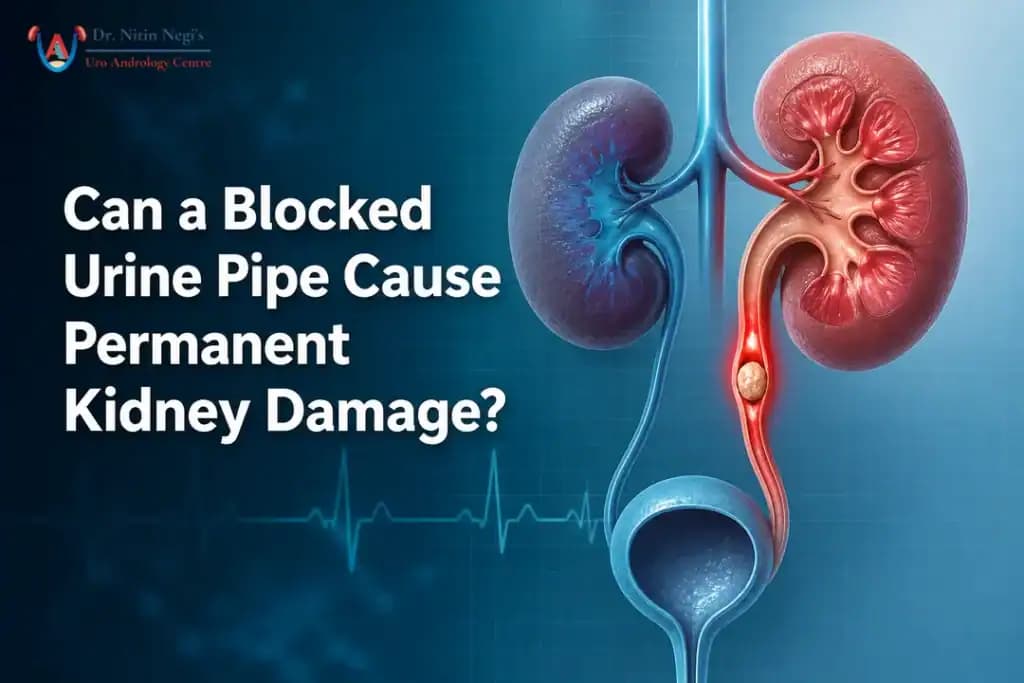
As a practicing urologist in Jaipur, I hear one anxious question almost every week: “Can a Blocked Urine Pipe Cause Permanent Kidney Damage?” The short answer is yes, a blocked urine pipe can harm the kidneys if you ignore the warning signs. In this guide, you will learn what causes blockage, how damage develops, when to seek urgent care, and which urology treatments protect your kidney health.
What Is a blocked urine pipe? Causes and risks
Your urinary tract includes two kidneys, two ureters, a bladder, and a urethra. When urine cannot flow freely at any point along this path, doctors call it a blockage or obstruction. Sometimes the stop is partial. Often it is complete. Either way, pressure builds behind the point of obstruction.
In our Jaipur practice, we most often see three culprits. First, kidney stones wedge in the ureter and behave like a cork. Second, an enlarged prostate (BPH) compresses the urethra and slows the stream. Third, scars called strictures narrow the urethra after infections, injuries, or old catheters. Less commonly, tumors, blood clots, or congenital kinks block flow.
Each cause carries unique risks. For example, a stone can also infect the kidney. Meanwhile, prostate swelling may trigger long nights of urinary retention. Importantly, even a short blockage can stress the kidneys. If infection joins the picture, the danger rises fast.
How urinary obstruction damages the kidneys
To understand damage, think plumbing and pressure. Your kidneys make urine continuously. If urine backs up, pressure inside the kidney rises and the collecting system balloons. Specialists call this hydronephrosis. The tiny filtering units then receive less blood and oxygen. Over time, they lose function.
Pressure and Hydronephrosis
The National Institute of Diabetes and Digestive and Kidney Diseases explains that obstruction raises pressure, causing hydronephrosis and potential kidney injury if not relieved in time. Read more from the NIDDK on this process in their overview of hydronephrosis and hydroureter. Because of this, speed truly matters.
Why time matters
Early relief allows kidneys to rebound. However, long-standing pressure can cause scarring, shrinking, and permanent loss of filtering capacity. WHO notes that chronic kidney disease affects roughly one in ten adults worldwide, which underscores why preventing avoidable damage is critical. See the WHO fact sheet on chronic kidney disease for global context.
In addition, obstruction plus infection is an emergency. Bacteria multiply behind the blockage, and toxins can enter the bloodstream. Consequently, fever with back pain and blocked flow requires same-day hospital care.
Symptoms, red flags, and when to see a urologist
Symptoms vary with the site and severity of the blockage. Some are subtle. Others shout for help. You should listen to both.
- Sharp flank pain that travels toward the groin, especially with nausea.
- Burning urination, frequent urges, or a weak, stop–start stream.
- Pink, red, or brown urine (blood in urine).
- Inability to pass urine despite a strong urge.
- Fever, chills, and vomiting with urinary symptoms.
For example, a young adult with colicky pain may have a stone. In contrast, a man with slow flow and night-time urination may have prostate enlargement. Women can develop blockages from stones or severe infections as well.
Emergency symptoms you should never ignore
Seek urgent care if you have any of the following: fever with back or side pain, complete inability to urinate, severe one-sided pain with vomiting, new confusion in an older adult, or pain after a recent urinary procedure. MedlinePlus describes these features under urinary tract obstruction and stresses the need for quick evaluation.
If you suspect a blocked urine pipe, call a urology doctor the same day. Prompt attention prevents complications and reduces pain.
Diagnosis and treatment options
We start with a focused history and a gentle abdominal and genital exam. Then we check urine for blood and infection. Because stones and swelling can hide, we often request an ultrasound. It is quick, safe, and excellent for spotting hydronephrosis. When more detail is needed, we use a low-dose CT scan. Blood tests help us gauge kidney function.
Once we confirm the site of blockage, we choose the fastest, least invasive way to restore flow. Importantly, the plan always balances relief, infection control, and future prevention.
Treating a blocked urine pipe: step by step
Care depends on the cause, but our approach usually follows a clear path:
- Pain control and hydration first, because comfort and kidney perfusion matter.
- Antibiotics when infection is present, guided by culture results.
- Immediate drainage if urine is trapped: a ureteral stent through the bladder or a small tube from the back (nephrostomy).
- Definitive treatment next. For stones, we prefer endoscopic removal or laser kidney stone surgery for precise fragmentation.
- For BPH, medicines relax or shrink the prostate. When needed, minimally invasive options such as laser prostate surgery or other BPH treatment relieve the obstruction.
- For strictures, we perform endoscopic dilation or reconstructive urology as required.
In our work across Jaipur, we rely on minimally invasive urology surgery to get patients home faster. As a result, most stone and prostate procedures use tiny scopes with rapid recovery. However, complex tumors may need a different pathway. In those cases, we coordinate with oncology and consider advanced options, including robotic urology surgery when appropriate.
Patients often ask about safety. Therefore, we discuss benefits and trade‑offs for every option. For example, stents relieve pressure quickly, yet they can cause temporary urgency. Likewise, stone dusting is gentle on tissue, though larger stones may need staged sessions. You and your surgeon decide together.
Prevention, recovery, and long‑term kidney care
After relief, kidneys need support. Recovery times vary with age, hydration, infection status, and how long the blockage lasted. Many patients regain full function. Some experience a slower flow for a short period as swelling settles. We monitor blood tests and imaging to confirm improvement.
Prevention is the real win. Here are practical, doctor‑tested steps:
- Hydrate steadily through the day. Clear or pale-yellow urine is a good target.
- Limit excess salt and refined sugar to reduce stone risk.
- Follow stone‑specific diet advice if your analysis shows calcium oxalate, uric acid, or cystine components.
- Empty your bladder completely. Avoid holding urine for long periods.
- Treat urinary tract infections early to prevent scarring and strictures.
- Manage prostate health with regular checkups, especially if you notice a weak stream or night-time urination.
Moreover, periodic reviews protect your kidneys even when you feel fine. We advise ultrasound or a simple kidney profile for anyone with a history of stones, severe UTIs, or prior urinary retention. Importantly, people with diabetes, hypertension, or a family history of kidney disease should stay extra vigilant.
At our clinic, we see patterns repeat. When people act early, they avoid surgery or need only small endoscopic procedures. When they wait, infections, hydronephrosis, and hospital stays become more likely. Therefore, listen to your body and seek timely urology treatment.
If you want trusted care in Rajasthan, you can reach our team through Dr. Nitin Negi’s Uro‑Andrology Centre. You can also explore kidney stone treatment, prostate treatment, male health, and urinary tract care details on our urology clinic homepage.
In short, obstruction is treatable, and modern tools make care gentle. Still, kidneys dislike pressure. If symptoms suggest a blocked urine pipe, do not delay. A quick visit can protect years of kidney function and preserve quality of life.
Conclusion: Can a blocked urine pipe cause permanent kidney damage? Yes, if you wait too long or add infection to the mix. Yet with early diagnosis, targeted antibiotics when needed, and definitive procedures such as kidney stone removal or BPH treatment, most people do very well. If you need guidance, we are happy to help without pressure.
As an experienced regional team, we publish these healthcare blogs to support patient education. Treatments and outcomes vary by person, and no article can replace a personalized consult. Please use this information to start a clear, confident conversation with your specialist.
Contact Dr. Nitin Negi, Urologist in Jaipur
📞 Phone: 9145888224, 9649888222
🏥 Hospital Address: MangalamPlus Medicity, Jaipur
🏥 Clinic Address: VS MediHUB,Jaipur