
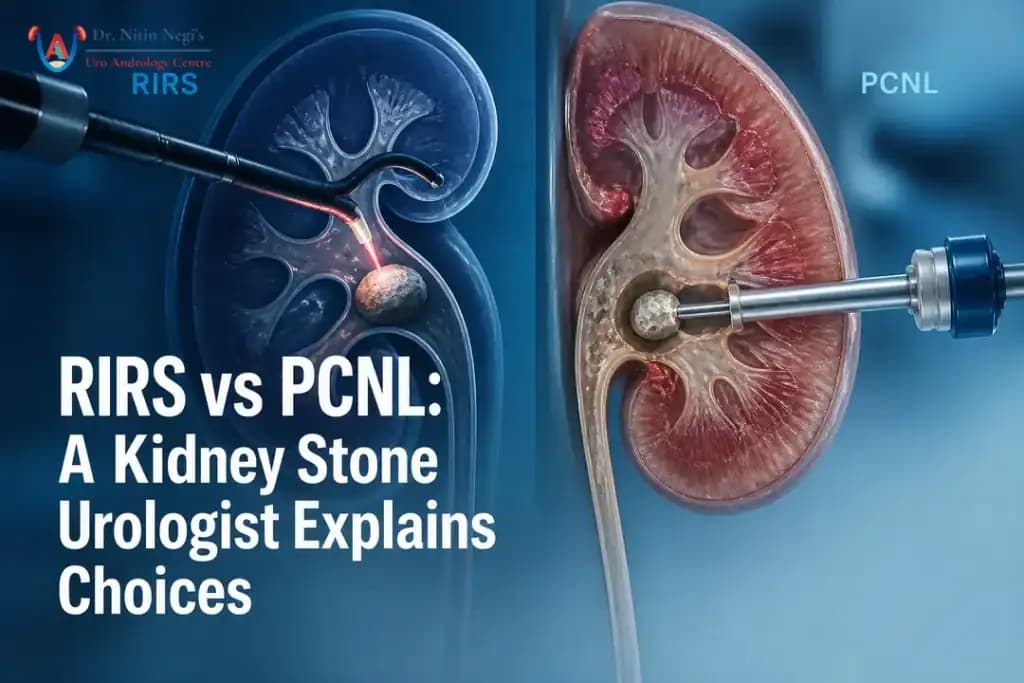
In RIRS vs PCNL: A Kidney Stone Urologist Explains Choices, we break down how doctors decide between two laser-era procedures for the same stone. This guide shows what matters and what to ask at your consultation.
When RIRS vs PCNL Matters for the Same Stone
Many people assume one kidney stone means one standard surgery. However, the best approach depends on size, location, shape, and your health. Two modern options dominate discussions today: RIRS and PCNL. RIRS (retrograde intrarenal surgery) uses a flexible scope passed through the urinary channel to reach the kidney and dust the stone with a laser. PCNL (percutaneous nephrolithotomy) creates a tiny track through the back to remove the stone directly.
In our everyday practice, we often meet two patients with 15–20 mm stones who need different plans. One patient may have a narrow ureter, a high stone density, and a history of urinary infections. Another patient may have a soft stone sitting in an easily reachable lower pole. Because of these differences, we might recommend PCNL for the first patient and RIRS for the second, even though their scans show a similar stone size.
Importantly, your anatomy guides the decision. For example, a steep lower-pole infundibulopelvic angle can make it harder to reach a stone with a flexible scope. Conversely, a single upper-pole stone with a favorable angle often suits RIRS very well. Your medical profile also matters. If you take blood thinners or have obesity, we consider safety, positioning, and bleeding risks before choosing.
When to see a urology doctor urgently
- High fever with chills and flank pain
- Persistent vomiting or inability to keep fluids down
- Severe pain not relieved by tablets
- Reduced urine output or visible blood in urine
- Pain with a known solitary kidney or in pregnancy
If any of these occur, do not wait. Seek emergency care and inform the team about prior scans or treatments.
How a Kidney Stone Urologist Chooses Safely
First, we review imaging in detail. A non-contrast CT scan tells us stone size, density (Hounsfield units), and exact location. Ultrasound may show hydronephrosis. Then we check infection markers, kidney function, and medications. Because of this full picture, we can match the procedure to your needs.
Guidelines help set baselines. According to the American Urological Association surgical management guideline, PCNL is recommended as first-line for renal stones larger than 20 mm. Meanwhile, flexible ureteroscopy (RIRS) works well for many stones under 20 mm, especially when anatomy is favorable. These are starting points, not rigid rules. For instance, a 12–15 mm stone with very high density might still justify PCNL if prior endoscopic attempts failed.
We also consider stone composition and fragility. For example, uric acid stones usually fragment easily with laser. Calcium oxalate monohydrate stones are hard and may take longer to dust. The NIDDK explains how chemistry, hydration, and diet shape stone formation. Therefore, pre-op planning plus preventive advice after surgery are both vital.
Finally, safety wins over speed. If urine infection exists, we treat it first and may stage the procedure. For a single kidney or severe hydronephrosis, we secure drainage quickly. When choices are close, we discuss both routes with you and tailor the plan to your goals, pain tolerance, and work schedule.
Procedure Steps, Risks, and Recovery
RIRS: Flexible scope, laser, day-care
During RIRS, we pass a thin scope through the urethra and ureter into the kidney. We use a holmium or thulium fiber laser to dust the stone. Often, a soft stent supports the ureter for a short period after surgery. Most patients walk the same day and resume light activity quickly. Because there is no back incision, discomfort is usually modest.
Who benefits most from RIRS
We often prefer RIRS for stones under 20 mm, stones in accessible calyces, people who need a short recovery, and those who must avoid a back puncture. It also suits patients on certain blood thinners when risks are carefully balanced with the cardiology team. However, it may require staged sessions for very hard or multiple stones. Therefore, we set expectations upfront.
PCNL: A mini track for bigger stones
PCNL creates a narrow channel from the skin into the kidney under x-ray or ultrasound guidance. Through this mini track, we use energy and instruments to break and extract stones. Various sizes exist, from standard to mini and ultra-mini PCNL. Because we remove larger fragments directly, stone clearance can be excellent for big or complex stones. Hospital stay is usually a bit longer than RIRS, and temporary tubes or stents may be used.
Bleeding and injury risks exist with any puncture. That said, experienced teams reduce these risks with careful access and imaging. In our center, we review your clotting profile, adjust medications in coordination with your physician, and plan the safest tract. Consequently, many patients leave with high confidence in the result and a clear follow-up plan.
Hydration and infection control shape recovery for both options. The World Health Organization’s advice on safe drinking water underscores why clean, adequate fluids matter. After your procedure, we guide you on water intake, pain control, and activity. In addition, we advise when you can travel, work, or exercise again.
If you want to understand our approach in Jaipur, explore the clinic homepage for an overview of services and appointments: Dr. Nitin Negi — Uro Andrology Centre.
Questions to Ask Your Kidney Stone Urologist
Preparing good questions helps you choose confidently. Use this list during your visit and add personal concerns as needed.
- What makes you prefer RIRS or PCNL for my scan and symptoms?
- Will I likely need one session or more than one? Why?
- How will you manage pain, stents, and return to work?
- What are my specific bleeding and infection risks?
- How will we prevent new stones after treatment?
- What costs and hospital stay should I plan for in my case?
Importantly, ask to see your images on the screen. When you see the stone’s position and angle, the recommendation makes more sense. Clear visuals reduce anxiety and improve adherence to the plan.
When to discuss lifestyle and prevention
Prevention starts the same week as your treatment plan. We discuss hydration, salt moderation, and a tailored diet. For recurring stones, we may advise a metabolic evaluation. That might include 24-hour urine testing and selected blood work. As a result, we treat the cause, not just the stone you see today.
Some patients ask about shockwave therapy (ESWL). For certain small stones, ESWL still has a role. Yet for many renal stones near 15–20 mm, RIRS or PCNL often offers more predictable clearance. We will explain if ESWL fits your anatomy and expectations.
Cost, access, and planning in India
Access to modern lasers and mini-PCNL instruments has improved across India. Nevertheless, costs vary by hospital level, device use, and whether you need staged care. We remain transparent about these aspects before booking your date. If insurance applies, our team helps with documentation and medical summaries.
Scheduling matters. For instance, if your job requires travel or lifting, we time surgery to minimize disruption. Moreover, we provide letters for leave and activity restrictions as needed. Good planning reduces stress and speeds recovery.
Putting It All Together: Choosing Confidently
RIRS and PCNL both aim for stone clearance with minimal trauma. The best choice comes from a structured review of your scans, infection status, anatomy, and goals. For stones larger than 20 mm, PCNL leads in most guidelines. For smaller or favorably positioned stones, RIRS often wins on comfort and recovery. Still, exceptions exist. Therefore, a candid discussion with your surgeon remains essential.
From years of treating stones, one pattern stands out. Successful outcomes start with two things: preparation and prevention. First, we stabilize pain and infection, then plan the right access. Next, we remove or dust the stone efficiently. Finally, we prevent the next episode through diet, hydration, and tailored medications when needed.
If you feel uncertain, bring a family member to the visit. Together, you can note risks, benefits, and timelines. In short, informed patients heal better and avoid repeat emergencies. For guidance or a second opinion, you can also visit our main page: advanced urology care in Jaipur.
As a final note, results vary with stone biology and patient health. No single plan suits everyone, and some cases require staged treatment. However, with a thorough assessment and clear goals, your team can match the procedure to your unique situation.
To conclude, a kidney stone urologist weighs anatomy, stone features, and safety to decide between RIRS and PCNL. With the right plan and follow-up, you can get relief now and protect your kidneys for the long term.
Contact Dr. Nitin Negi, Urologist in Jaipur
📞 Phone: 9145888224, 9649888222
🏥 Hospital Address: MangalamPlus Medicity, Jaipur
🏥 Clinic Address: VS MediHUB,Jaipur