
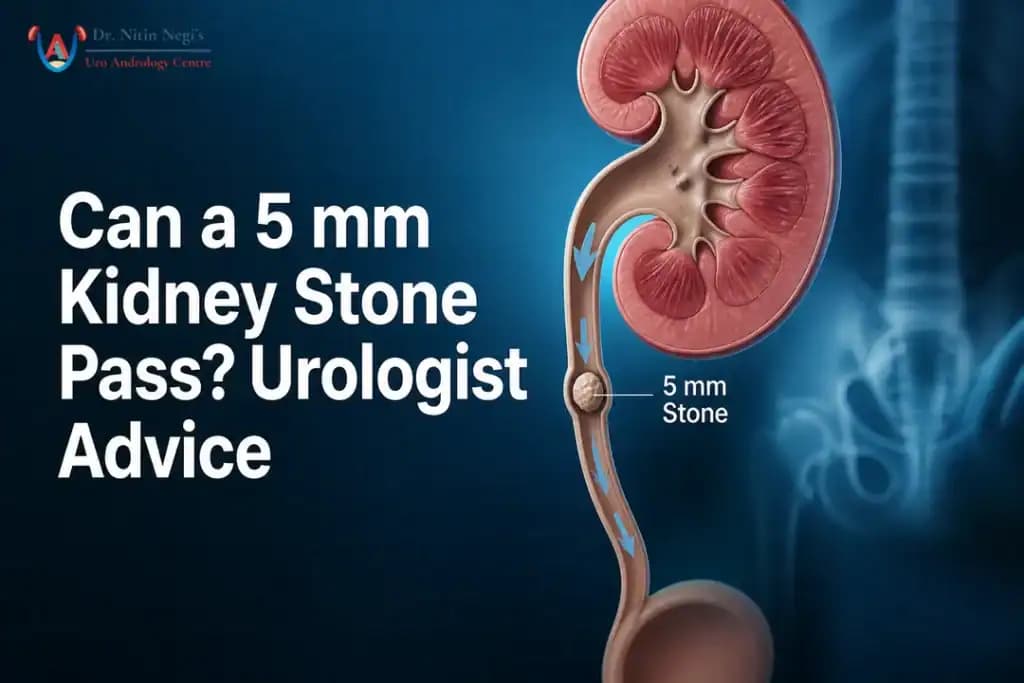
Patients often ask a urologist one urgent question: “Can a 5 mm Kidney Stone Pass? Urologist Advice.” In this clear guide, you will learn what truly determines stone passage, how long it may take, what to do at home, and when treatment makes better sense.
What Determines Whether a 5 mm Stone Will Pass
The odds depend on simple mechanics. A stone must navigate from the kidney into the ureter and down to the bladder. Therefore, size, shape, and location matter most. Your general health and hydration influence the journey as well.
In our daily work with patients in Jaipur, we see a pattern. Many 4–6 mm ureteral stones pass with careful monitoring and pain control. However, a few get stuck at narrow points and need help. Knowing these choke points reduces worry and prevents delays.
Size, shape, and location matter
Size is the first filter. A stone around 5 mm sits on the cusp between likely and uncertain passage. Next, shape matters. Smooth stones travel more easily than jagged ones. Finally, location guides decisions. Stones already in the lower ureter tend to pass sooner than those at the top.
Stone location basics: UPJ, UVJ, mid-ureter
Three places often slow a stone. First, the ureteropelvic junction (UPJ) where the kidney meets the ureter. Second, the mid-ureter as it crosses pelvic structures. Third, the ureterovesical junction (UVJ) where the ureter enters the bladder. Consequently, a stone at the UVJ may trigger urinary urgency but often passes next.
Symptoms and timeline: what your pain says
Colicky flank pain suggests the stone moves. Nausea, vomiting, or pain that comes in waves often means the ureter squeezes against the stone. In contrast, steady worsening pain with fever can indicate infection behind a blockage. That situation needs urgent care.
According to the U.S. National Institute of Diabetes and Digestive and Kidney Diseases (NIDDK), many small stones can pass within a few weeks, and clinicians may observe for up to 4–6 weeks when it is safe to wait. You can review their guidance on kidney stone treatment at the NIDDK treatment page.
When to See a urologist for a 5 mm Stone
Sometimes waiting becomes risky. Book a same-day review if any red flag appears. Early action protects kidney function and prevents infection.
- Fever, chills, or burning urine. These can signal an infection above a blockage.
- Uncontrolled pain or vomiting despite medicines. Persistent distress needs rapid relief.
- Little or no urine output, or a swollen kidney on scan. That suggests obstruction.
- One working kidney, a kidney transplant, or pregnancy. These cases require closer monitoring.
- Blood in urine that does not settle, or severe weakness. These can reflect complications.
If you are uncertain, contact a trusted local specialist. For friendly guidance and quick imaging access in Jaipur, visit Dr. Nitin Negi’s urology clinic. We help you decide whether to keep waiting or to plan treatment.
Self-Care While You Wait: Hydration, Pain, Red Flags
While you wait for a possible natural passage, good habits reduce risk. First, drink water steadily through the day. The NIDDK advises patients to drink enough fluids to make about two liters of urine daily; this target supports passage and prevention. See the NIDDK overview of kidney stones for more detail.
Next, use pain control as directed. Simple anti-inflammatories like ibuprofen can lower ureteral spasm and ease movement. However, check with a clinician if you have ulcers, kidney disease, or you take blood thinners. As a result, you can stay active and avoid dehydration from pain-induced vomiting.
Safe fluid targets and activity
Aim for pale-yellow urine, which signals good hydration. For example, sip 200–250 ml every hour while awake, unless a doctor has limited your fluids. Moreover, gentle walking helps the ureter’s natural rhythm. Many patients also use a warm pack on the flank to relax muscles.
Strain your urine with a clean filter if possible. Capturing the stone lets us analyze its content later. In fact, composition testing guides diet choices that prevent the next stone.
Track symptoms in a small notebook. Note pain scores, medicines, water intake, and any visible blood in urine. Consequently, your clinician can adjust the plan with better accuracy.
urologist Treatments If It Doesn’t Pass
When observation fails or risks climb, modern procedures solve the problem with minimal trauma. Our clinic plans the least invasive option that fits your anatomy, work schedule, and comfort.
First, we confirm the location with an ultrasound or a low-dose CT. Then we discuss medical expulsive therapy, shock waves, or endoscopic laser treatment. The right choice depends on the stone’s size, density, and position.
Medical expulsive therapy uses an alpha blocker such as tamsulosin. Evidence shows it can help stones in the ureter pass more easily for some patients. The NHS also notes that doctors may prescribe tamsulosin to relax the ureter and speed passage. You can read this on the NHS kidney stone treatment page.
Extracorporeal shock wave lithotripsy (ESWL) focuses sound waves on the stone. As a result, the stone breaks into sand-like pieces that pass in urine. ESWL works well for selected 5–10 mm stones in the kidney or upper ureter. However, it can bruise tissue and sometimes needs a repeat session.
Ureteroscopy with laser lithotripsy offers precise control. We pass a thin scope through the urethra and bladder into the ureter. Next, we fragment the stone with a laser and remove pieces with a basket. Consequently, most patients go home the same day. A temporary stent may support drainage during healing.
In our experience, careful planning makes recovery smooth. We guide patients on pain relief, fluid targets, and activity. Furthermore, we schedule follow-up imaging to confirm clearance and protect kidney function.
How doctors decide on timing
Timing is a balance. If your pain is controlled, urine flows well, and scans show no strain on the kidney, we may continue observation for several weeks. Conversely, we treat sooner if fever, rising creatinine, or hydronephrosis appears. That approach preserves safety without rushing to procedures.
Importantly, NIDDK guidelines outline common treatments and the context for each. Their information supports shared decisions between you and your care team. Explore options at the same NIDDK treatment resource.
Will a 5 mm Stone Pass? Putting It All Together
Let’s distill the big picture. A 5 mm stone stands at a tipping point. Many will pass, especially once they reach the lower ureter. Others will sit at a junction or cause swelling. Therefore, risk signals and your daily function should tip the decision toward treatment.
Use this simple mental model:
- If pain improves, urine flows, and no fever appears, you can usually wait with guidance.
- If pain persists, urine output falls, or fever rises, you should treat sooner.
- If you have a solitary kidney, pregnancy, or weak kidneys, prioritize early review.
Meanwhile, keep lifestyle support strong. Hydrate, walk, and use heat when needed. In addition, strain urine to catch the stone and note any blood. Above all, seek help if anything feels worse or different.
Prevention after this stone clears
Prevention begins with more fluids. Aim to produce two liters of urine a day unless told otherwise. Next, reduce excess salt and moderate animal protein. For example, swap one meat serving for a plant protein several days a week. Finally, pair calcium foods with oxalate-rich foods during meals to reduce oxalate absorption. That pairing helps many patients lower risk.
Most stones are calcium based, according to the NIDDK, with calcium oxalate being the commonest type. Because of this, diet balance and hydration can markedly reduce future episodes. We individualize advice after reviewing your metabolic tests and stone analysis.
What we see in real practice
At our Jaipur clinic, people often arrive worried after a first attack. We explain the plan, treat pain, and arrange timely imaging. As a result, anxiety falls and recovery begins. Many 5 mm stones pass in the next few days. When they do not, we choose laser or shock wave treatment and aim for a quick, clean finish.
Ready for tailored care and fast answers? You can reach our team through the Dr. Nitin Negi Uro-Andrology Centre website. We prioritise clear decisions, minimal downtime, and safe outcomes.
Conclusion: Your Next Best Step
A 5 mm stone may pass on its own, yet the real answer depends on size, shape, and location, plus your symptoms and risks. Therefore, track red flags, hydrate, and use pain control wisely. If progress stalls or risk signs appear, speak with a urologist for a precise plan. Our goal is to relieve pain, protect kidneys, and prevent the next stone—without unnecessary delay.
Contact Dr. Nitin Negi, Urologist in Jaipur
📞 Phone: 9145888224, 9649888222
🏥 Hospital Address: MangalamPlus Medicity, Jaipur
🏥 Clinic Address: VS MediHUB,Jaipur