
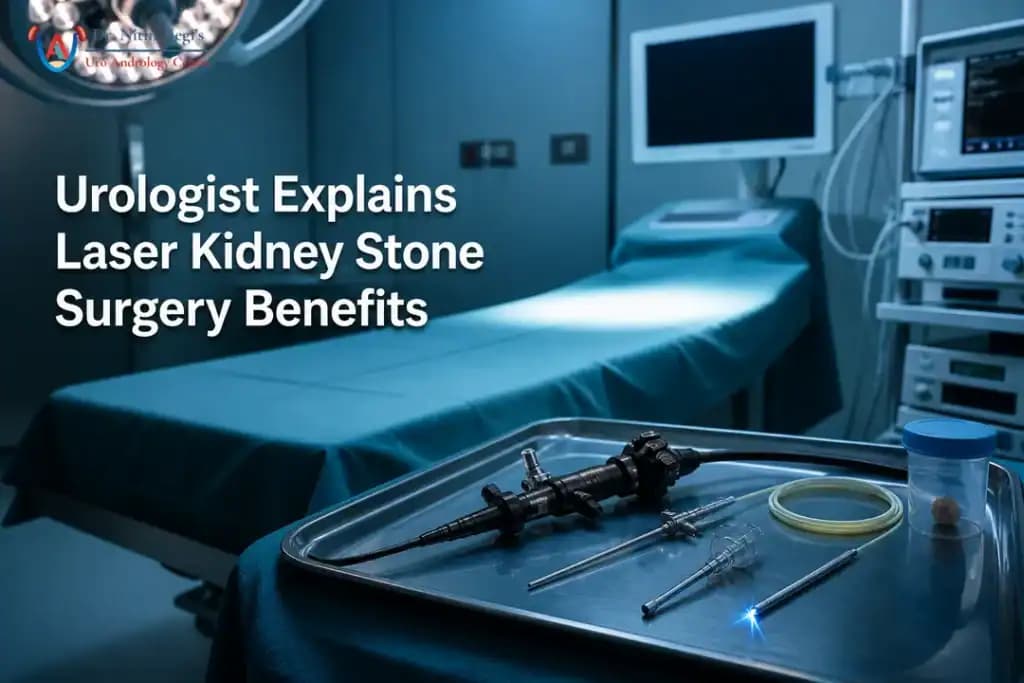
If you searched “Urologist Explains Laser Kidney Stone Surgery Benefits,” you likely want clear answers from a urologist before choosing a kidney stone treatment. In this guide, I will explain how laser kidney stone surgery works, who benefits most, what recovery looks like, and what limits you should know.
Why Laser Stone Surgery Has Become a Preferred Option
First, kidney stones cause pain because they block urine flow or scrape the urinary tract. As a result, patients often arrive with severe flank pain, nausea, hematuria, or urinary problems. When stones do not pass, a urology doctor may advise removal to protect kidney health.
Laser kidney stone surgery usually refers to endoscopic stone removal using a thin camera and a laser fiber. Most commonly, we use ureteroscopy or RIRS (retrograde intrarenal surgery). Importantly, these methods avoid large cuts, which supports faster mobility and less wound care.
In our day-to-day practice, one pattern we repeatedly see is delayed care after repeated pain episodes. However, repeated obstruction can lead to hydronephrosis and infection. Therefore, timely evaluation for kidney stone treatment matters more than many people realise.
How Laser Kidney Stone Surgery Works Inside the Body
During the procedure, the urologist passes a ureteroscope through the natural urine passage into the ureter or kidney. Next, we locate the stone and fragment it using a laser. After that, we remove pieces with a basket or allow fine dust to pass with urine.
Often, we place a temporary ureteric stent to keep drainage smooth. In addition, the stent reduces colic from swelling. Still, some patients feel urinary frequency or burning until we remove it.
What “Laser” Means in Simple Terms
Laser energy breaks a stone into smaller fragments. In fact, it works like controlled “dusting” or “fragmentation,” depending on stone type and size. Because of this control, we can target the stone while protecting surrounding tissue.
Key Benefits Patients Notice After Minimally Invasive Removal
Patients choose minimally invasive urology surgery for practical reasons. For example, they want less downtime and fewer visible scars. Moreover, they want reliable relief when stones keep recurring.
- No big incision, so wound pain and dressing needs stay minimal.
- Shorter hospital stay in many cases, depending on infection risk and stone load.
- Quick return to daily activity for many working adults.
- Access to kidney stones in locations that can be hard to reach with other methods.
- Fits a tailored plan, alongside diet advice for kidney stone prevention.
That said, results vary based on stone size, anatomy, and whether you have UTI symptoms or fever. Therefore, your urology treatment plan should match your scan and lab findings.
Urologist Guidance: Who Is a Good Candidate?
Laser approaches can treat many stones, but not all situations suit the same method. Notably, a urologist decides based on the stone’s size, position, hardness, and your health status. Therefore, a CT scan report and urine tests guide the safest choice.
Many patients ask if laser is “best” for everyone. However, large stones may need PCNL, while small stones may pass with medicines and hydration. Because of this, choosing the right kidney stone doctor matters as much as choosing the technique.
Common Scenarios Where Laser Helps Most
Laser stone surgery often fits patients with ureteric stones or kidney stones that cause repeated pain. In addition, it helps when medicines fail or when stones cause urinary retention due to obstruction. Furthermore, it can be useful when hematuria appears with stone symptoms.
It also suits many patients who want a minimally invasive route. For instance, people with work commitments often ask for a quicker functional recovery. Still, your medical history and anesthesia fitness remain key factors.
When Another Treatment May Be Better
Sometimes, the safest approach is not laser ureteroscopy. For example, a very large staghorn stone may respond better to PCNL. Similarly, untreated bladder infection or active fever may require antibiotics first.
Importantly, your urologist will also consider kidney function, bleeding risk, and anatomical narrowing. Consequently, a personalised plan prevents complications and improves success rates.
Laser Kidney Stone Surgery Benefits, Risks, and Recovery
When patients hear “laser,” they expect a simple one-step fix. However, stone disease behaves like a chronic tendency in many people. Therefore, the real win comes from removal plus prevention, not removal alone.
In our clinic, we counsel patients that comfort improves quickly, but mild burning or frequency can linger if a stent is present. Moreover, hydration and short walks help urine flow. As a result, many patients feel more confident during recovery.
What To Expect on Procedure Day
First, you undergo anesthesia, and we monitor vitals throughout. Next, we perform endoscopic access and laser fragmentation under direct vision. After that, you recover in a monitored area until you are stable.
Most people go home with medicines for pain control and spasm relief. In addition, we give clear instructions for fluids and warning signs. If we place a stent, we schedule removal at a planned time.
Possible Side Effects and Honest Limitations
Most patients do well, yet every procedure has trade-offs. For example, temporary hematuria can occur after ureteroscopy. Similarly, stent discomfort may cause urgency or flank ache.
Rarely, infection can occur, especially if bacteria already live in the urine. Therefore, pre-op urine culture and appropriate antibiotics matter. Additionally, very hard stones may need a staged procedure, which your urologist should explain upfront.
For patient safety, doctors follow evidence-based infection prevention steps. The World Health Organization highlights the importance of hand hygiene in healthcare settings, which supports safe surgical care and lowers infection risk: WHO guidance on infection prevention and hand hygiene.
After Surgery: Preventing Recurrence and Knowing When To Call
Even after successful kidney stone removal, prevention protects long-term urinary health. Therefore, we focus on fluids, diet, and follow-up testing. Importantly, recurrence risk differs based on stone chemistry and metabolic factors.
For ongoing education and appointments, you can explore Dr. Nitin Negi’s urology clinic resources. You can also review doctor background and approach at Dr. Nitin Negi’s official website.
Simple Prevention Habits That Support Kidney Health
First, aim for steady hydration so urine stays light in colour. Next, reduce excess salt, since high sodium can raise urinary calcium. In addition, do not overuse high-dose vitamin C unless your physician advises it.
If you form stones often, your urologist may suggest blood tests, 24-hour urine tests, or stone analysis. Notably, many stones contain calcium oxalate. For a plain-language overview of stone types and formation, see kidney stone basics on Wikipedia.
Red Flags That Need Urgent Urology Review
Call your urology doctor urgently if you develop fever, chills, or worsening flank pain. Similarly, seek help if you cannot pass urine, or if nausea prevents drinking fluids. Moreover, heavy bleeding with clots deserves immediate attention.
Finally, if you also have prostate health concerns, such as weak stream or urinary retention from enlarged prostate, tell your urologist. Sometimes BPH treatment or prostate treatment overlaps with stone care planning. That broader view helps protect urinary tract health across the long term.
Takeaway: “Urologist Explains Laser Kidney Stone Surgery Benefits” is not just a headline. It reflects what patients want most: safe stone clearance with a plan to avoid recurrence. A urologist can confirm if laser kidney stone surgery benefits you based on scans, urine tests, and your medical history. If you want a balanced opinion, book a consultation and bring your reports so you get a clear, non-rushed plan.
Contact Dr. Nitin Negi, Urologist in Jaipur
📞 Phone: 9145888224, 9649888222
🏥 Hospital Address: MangalamPlus Medicity, Jaipur
🏥 Clinic Address: VS MediHUB,Jaipur