
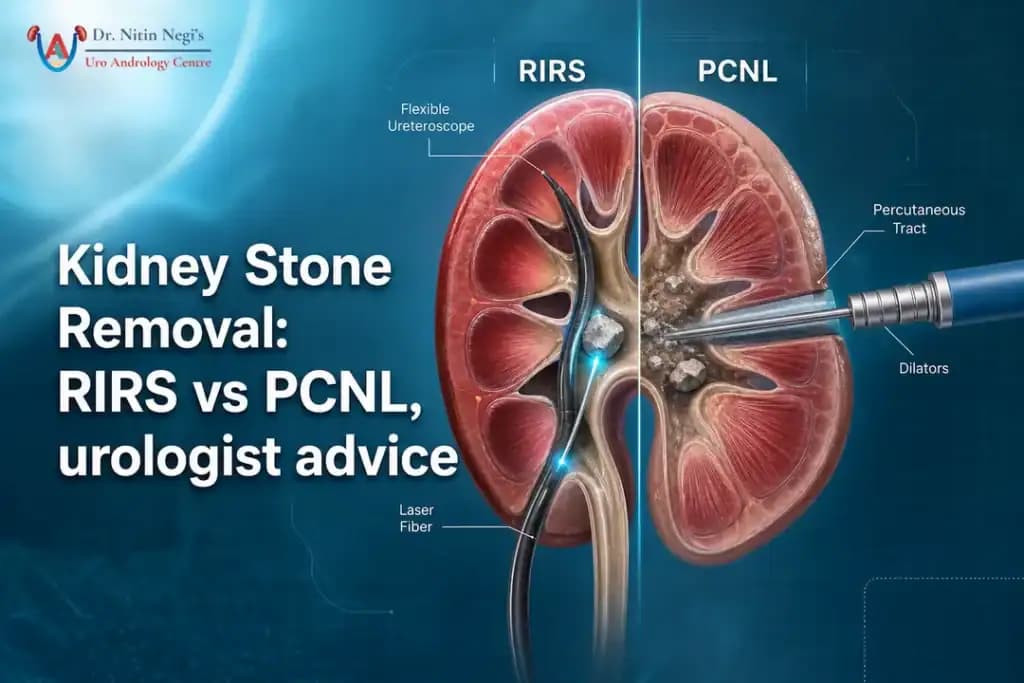
If you are comparing options for stone surgery, this guide — Kidney Stone Removal: RIRS vs PCNL, urologist advice — explains the differences clearly. The exact choice affects pain, safety, recovery, and cost. In our Jaipur practice, we help patients decide every week. You will leave knowing which procedure suits your stone and how to prepare well. For trusted care, explore Dr. Nitin Negi’s Uro Andrology Centre.
What Are RIRS and PCNL? How They Remove Stones
RIRS (Retrograde Intrarenal Surgery)
RIRS uses a thin flexible scope passed through the urethra and bladder into the kidney. The surgeon sees the stone on a camera and dusts it with a laser. Because we use natural channels, there is no skin incision. As a result, recovery is usually quicker and bleeding risk stays low.
Flexible scope and laser basics
During RIRS, we often use a holmium or thulium fiber laser to fragment the stone. Small pieces wash out through a fine sheath or a basket. Sometimes we place a temporary stent to keep urine flowing. That stent prevents blockage from swelling and small fragments.
PCNL (Percutaneous Nephrolithotomy)
PCNL creates a tiny track from the back into the kidney. Through this channel we pass instruments that break and remove large stones directly. Therefore, PCNL suits big or complex stones that would take too long with a scope alone. We usually place a drain or stent for short-term safety.
Both methods aim to clear stones while protecting the kidney. However, the tools and access differ. Consequently, the best choice depends on your stone’s size, number, hardness, and exact location.
When Each Procedure Works Best: Size, Location, and Safety
First, size matters. For stones smaller than 2 cm, RIRS often works well and avoids a back puncture. For stones larger than 2 cm, PCNL usually clears more in one sitting. This matches global practice patterns we see in our clinic.
Second, location guides the plan. Lower pole stones with a tight angle may resist RIRS because the scope bends sharply. In these cases, we discuss PCNL for higher clearance. Conversely, stones in the pelvis or upper pole often suit RIRS because access remains straight.
Decision factors your urology doctor weighs
Importantly, we judge more than size. We study hardness on CT Hounsfield units, your body habitus, bleeding risk, and prior surgeries. We also consider job demands and travel constraints. For example, a traveler who needs a quick return might favor RIRS if the stone allows it. On the other hand, a giant staghorn calculus usually needs PCNL because it fills the kidney.
Evidence helps guide these talks. According to the U.S. National Institute of Diabetes and Digestive and Kidney Diseases, nearly one in eleven people will form a kidney stone, and treatment choice depends on stone features and symptoms (NIDDK overview of kidney stones). Furthermore, meta-analyses show PCNL achieves higher single-session stone-free rates for large stones, while RIRS offers shorter hospitalization for smaller stones (peer‑reviewed summaries on PubMed). We pair such data with your goals to make a balanced plan.
Safety remains central. With PCNL, we manage bleeding and injury risk by using ultrasound or fluoroscopic guidance and by planning the tract carefully. With RIRS, we watch for ureteric injury, pressure buildup, and infection. Therefore, we tailor antibiotics and hydration before surgery, especially if you had a recent urinary infection.
Recovery, Risks, and Costs — urologist advice
From a recovery standpoint, patients usually walk the same day after RIRS. Discomfort tends to be mild, and many return to routine in two to four days. After PCNL, most people need a few more days because the back puncture must heal. Even then, we encourage early movement to reduce clots and stiffness.
Risks differ slightly. After RIRS, you may feel urinary urgency from the stent, and you may pass sandy fragments. After PCNL, back soreness and blood in urine can last a bit longer. However, serious problems are uncommon in expert hands. We reduce them with careful planning and by stopping blood thinners at the right time.
Cost varies by hospital, device choice, and stay length. RIRS may cost less when an overnight stay is not needed. PCNL may cost more upfront but can finish clearance for very large stones in one session. Consequently, the total journey often evens out when we look at time off work and re-treatments. We discuss these realities so you can budget with confidence.
- RIRS: no skin incision, laser dusting, fast recovery, stent common.
- PCNL: tiny back tract, removes big stones directly, higher one‑sitting clearance.
- RIRS best for stones under 2 cm or favorable anatomy.
- PCNL preferred for stones over 2 cm, hard stones, or staghorn shapes.
- Both need hydration, infection control, and imaging follow‑up.
Globally, stone disease burdens kidneys and quality of life. The World Health Organization highlights the rising impact of noncommunicable diseases on kidney health, which includes conditions that raise stone risk such as diabetes and obesity (WHO information on kidney health). Because of this, prevention and timely surgery matter equally.
Preparing and Healing After Surgery: Practical Steps
Good preparation reduces risk and speeds recovery. We start with a detailed review of medicines, allergies, and prior anesthesia records. Then we order blood tests, urine culture, and CT or ultrasound to map the stone. If infection shows on culture, we treat it before entering the urinary tract. This one step prevents many complications.
On the day before surgery, hydrate well unless your anesthetist advises limits. Eat light, and stop solids as instructed. Importantly, arrange a family member to help at discharge. Bring all previous reports in one folder. These small actions keep your day smooth.
After RIRS or PCNL, you will pass blood‑tinged urine for a short while. Therefore, drink two to three liters daily unless your heart doctor restricts fluids. Walk gently, and avoid weights for a week. For pain, we use simple medicines first. If you have a stent, expect some urinary urgency. Warm baths and antispasmodics make this easier.
We schedule follow‑up imaging to confirm clearance. Next, we test stone composition when possible. That result guides diet and medicine to prevent future stones. For instance, high oxalate stones respond to lower oxalate foods, higher citrate from lemons, and steady hydration. Meanwhile, uric acid stones respond to alkalinization and gout control.
Diet and lifestyle support your kidney for life. Aim for clear or pale-yellow urine. Limit salt and animal protein. Add fruits and vegetables rich in citrate. Moreover, maintain a healthy weight and an active routine. These habits lower repeat stone risk.
For questions or appointments, you can also visit the clinic homepage for trusted urology treatment. We keep advice practical and individualized.
Choosing a Specialist in Jaipur — urologist advice
In our experience, outcomes depend as much on planning as on tools. Therefore, choose a team that performs both procedures regularly. Ask how they decide between RIRS and PCNL for a stone like yours. Ask who places the stent, who monitors pressure, and who manages antibiotics. Clear answers indicate a robust system.
Additionally, discuss anesthesia options and pain control. Spinal or general anesthesia may be suitable depending on the case. Confirm emergency protocols, imaging support, and postoperative nursing. Finally, request a written plan that lists medicines, activity limits, and follow‑up timelines. That plan keeps everyone aligned.
We base our guidance on real cases. For example, a young executive with a 12 mm upper pole stone returned to work two days after RIRS. In contrast, a senior patient with a 3.2 cm staghorn cleared fully with a single PCNL and spent three nights in the hospital. Neither approach is “always best.” The right choice matches the stone and the person.
FAQs Patients Ask Before Deciding
Will I need more than one procedure?
Sometimes yes. With RIRS, very hard or multiple stones may need a staged approach. With PCNL, complex staghorn stones might need a second tract or a second look. Nevertheless, we plan to finish in the fewest sittings that remain safe.
Is the stent painful?
It is not harmful, but it can cause urgency and flank twinges. Thankfully, these symptoms ease with medicines, hydration, and time. We remove the stent when swelling settles, often within one to three weeks.
How soon can I travel?
After RIRS, many patients travel within three to five days. After PCNL, we advise a week or a bit more. However, if you develop fever, severe pain, or heavy bleeding, delay travel and call your team promptly.
Can stones be prevented?
Prevention is possible for many people. Keep urine dilute, moderate salt and animal protein, and follow stone‑type advice. Your plan may include citrate or other medicines. Regular follow‑up protects your kidney for the long term.
Conclusion: Make a Confident, Informed Choice
RIRS and PCNL both remove stones effectively when matched to the right case. RIRS favors smaller or accessible stones and a rapid return to life. PCNL excels for big or branching stones that need decisive clearance. Importantly, the best decision blends imaging facts, your health, and personal goals. If you want clear next steps, reach out for tailored urologist advice and a measured second opinion. As a centre that performs both procedures routinely, we offer practical guidance without pressure and with transparent expectations.
Content on this page is for patient education and does not replace a face‑to‑face consult. Results vary by anatomy, stone chemistry, and other health conditions.
Contact Dr. Nitin Negi, Urologist in Jaipur
📞 Phone: 9145888224, 9649888222
🏥 Hospital Address: MangalamPlus Medicity, Jaipur
🏥 Clinic Address: VS MediHUB,Jaipur