
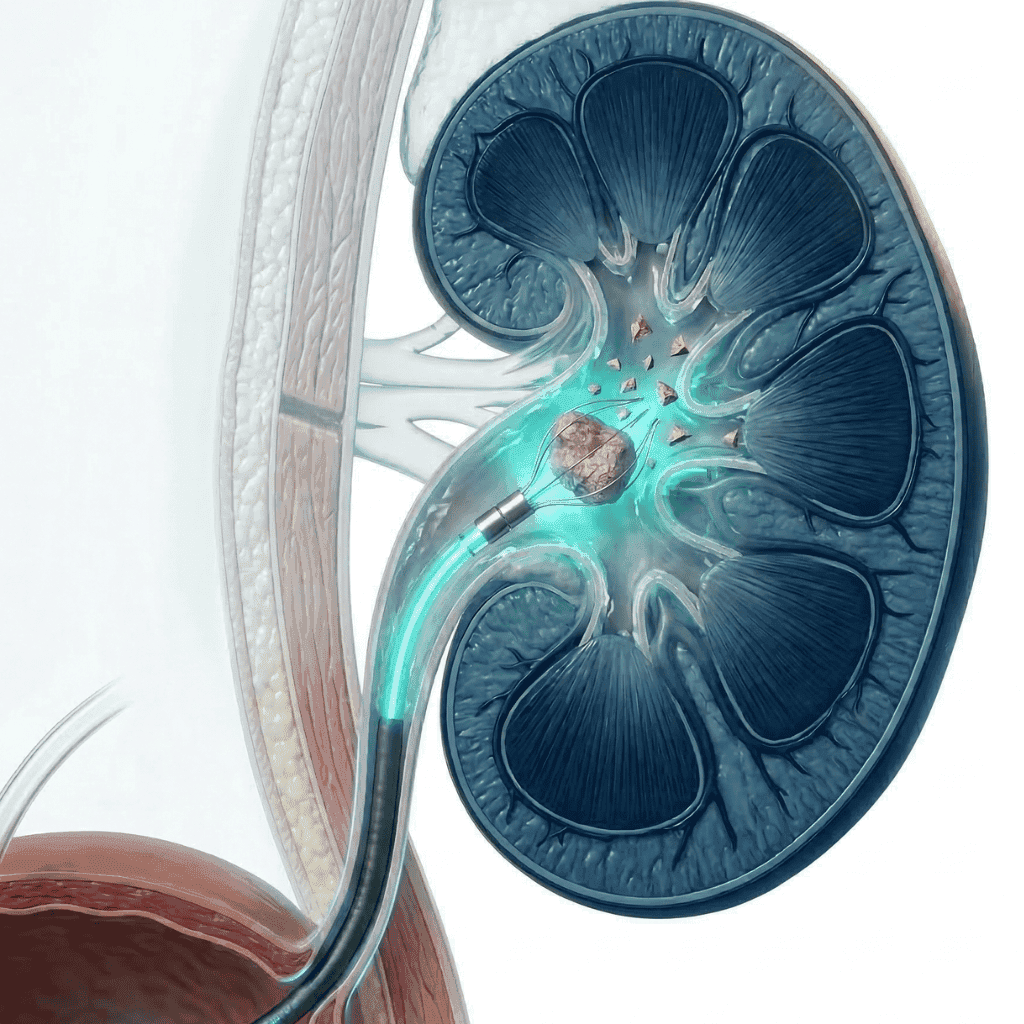
Kidney stones and urinary tract infections (UTIs) often travel together. A stone can trap bacteria and cause repeated infections, and some infections create stones. When the two combine with a blockage, it becomes a medical emergency.
How stones lead to infections
- A stone that blocks urine flow lets bacteria multiply behind it
- Bacteria hide in the stone’s surface, so antibiotics alone may not clear them
- Stents and incomplete emptying after stone episodes can add to the risk
How infections create stones
Certain bacteria (such as Proteus) produce an enzyme called urease that makes urine alkaline and leads to struvite stones. These grow fast and can fill the kidney as staghorn stones. They must be removed completely, usually by PCNL, or the infection keeps coming back. See types of kidney stones.
Emergency: fever with stone pain
Fever, chills or shaking with flank pain may mean an infected, blocked kidney. This can become life-threatening sepsis within hours. Go to hospital the same day. Treatment is to drain the kidney first, with a stent or a small tube, plus antibiotics; the stone is removed after the infection settles.
Symptoms to watch
| Symptom | Stone | UTI |
|---|---|---|
| Severe side or back pain | Common | Only with kidney infection |
| Burning while urinating | Sometimes, near the bladder | Common |
| Fever, chills | Only with infection | Kidney infection |
| Blood in urine | Common | Sometimes |
Repeated UTIs? Look for a stone
If you have more than two or three UTIs a year, an ultrasound or CT scan to look for stones or a blockage is worthwhile. Read recurrent UTI: when a urologist helps and burning urination.