
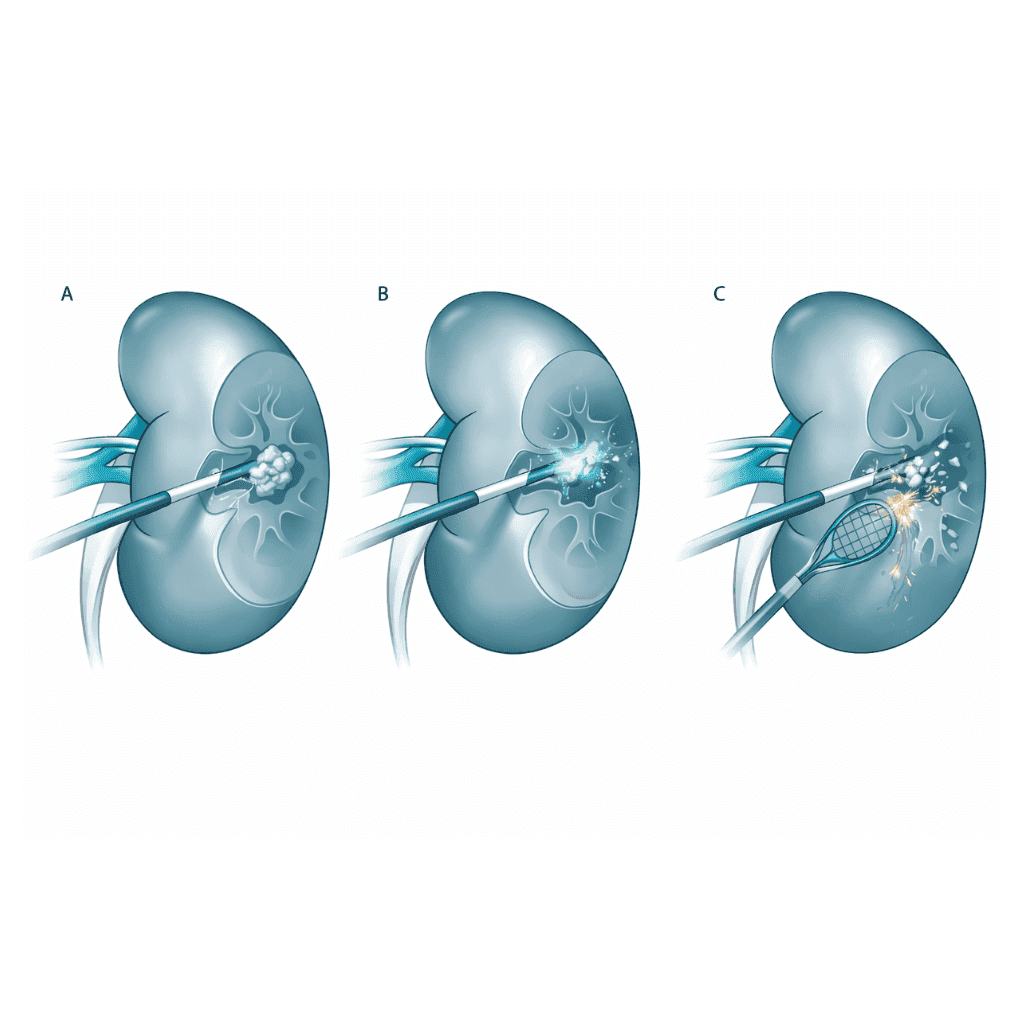
“What size is my stone, and will it pass?” is the first question most patients ask after a scan. There is no single “normal” size, because a healthy kidney should have no stone at all, but size and position strongly predict what happens next.
Kidney stone size chart
| Size | Chance of passing on its own | Usual approach |
|---|---|---|
| Under 4 mm | High (most pass within weeks) | Fluids, pain relief, follow-up scan |
| 4-6 mm | Moderate; better if in the lower ureter | Fluids plus tamsulosin; review in 2-4 weeks |
| 6-10 mm | Low | Often URS (ureter) or RIRS / ESWL (kidney) |
| 10-20 mm | Very unlikely | RIRS, Mini-PERC or ESWL depending on hardness and position |
| Over 20 mm | Will not pass | PCNL or Mini-PERC |
Size is not the only factor
- Position: stones in the lower ureter pass more easily than those higher up; stones inside the kidney may stay silent for years.
- Shape and hardness: jagged or very hard stones pass less easily.
- Infection or fever: any stone with infection needs urgent drainage, whatever its size.
- Kidney function: a single kidney or reduced function lowers the threshold for treatment.
Small stones that stay in the kidney
Small kidney stones that cause no pain or infection are sometimes monitored with periodic ultrasound. Treatment is advised if they grow, cause symptoms or infection, or for people such as pilots or frequent travellers who cannot risk a sudden stone attack.
Related: can a 5 mm stone pass? and how to pass a kidney stone.